Spatialworks Digital Twin
A digital twin platform taken from concept to six enterprise contracts in three years. I joined before the product existed, carried both design and product management, and shipped the working MVP that closed the first contract in four months for Keppel, DB Schenker and Hamburg Port to follow.
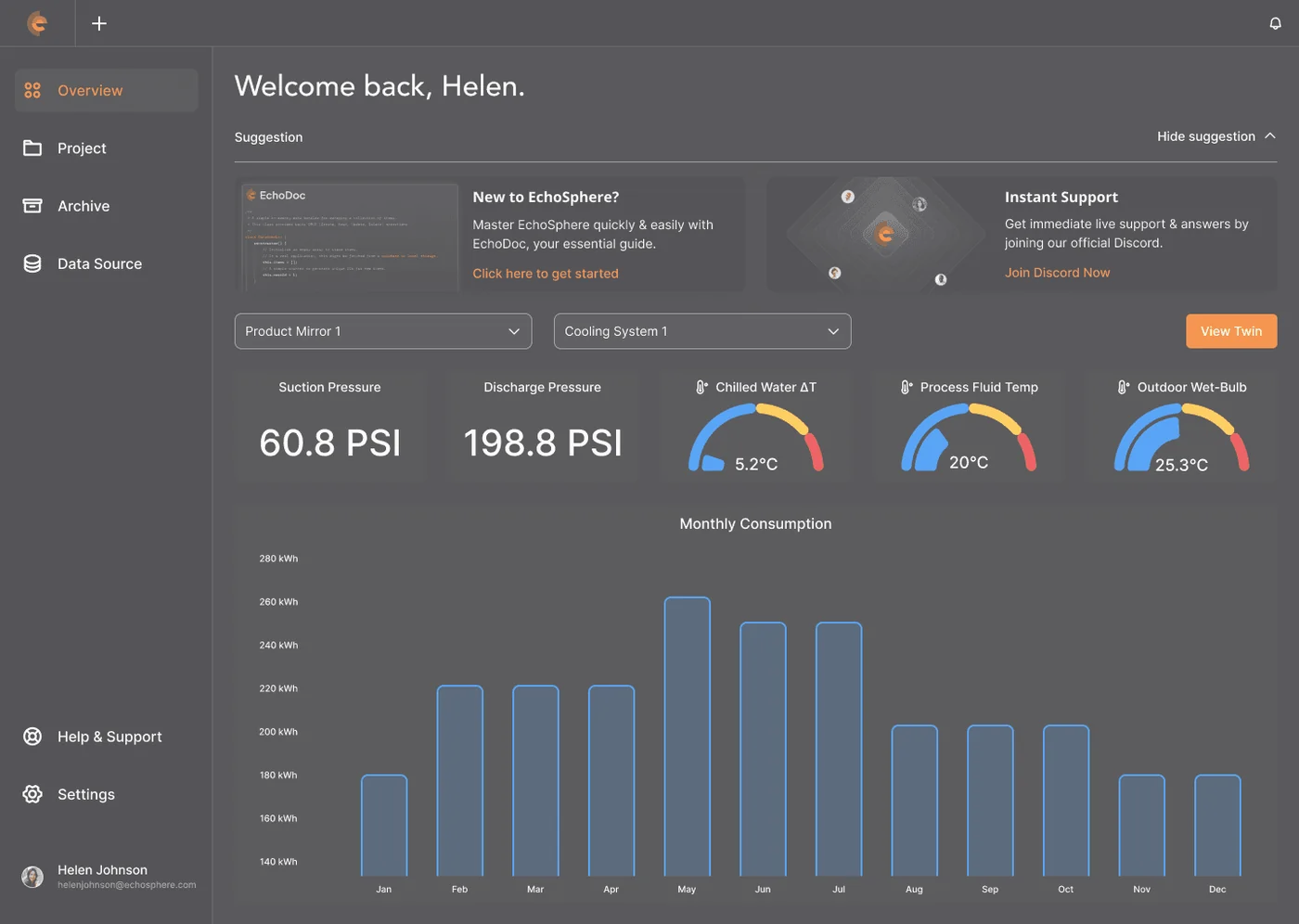
At a glance
Joined before the product existed and shipped the working MVP that closed the first enterprise contract in four months.
Six enterprise contracts in three years: Keppel, DB Schenker, Hamburg Port, Omron AGV, HP Indigo and JamK Cyber Sec, each on a different use case.
In the clients' own published numbers: Keppel cut on-site inspection times by 50% and DB Schenker improved goods handling efficiency by 30%.
Lead Product Designer carrying product management too — the roadmap, the scope and the client conversations sat with me alongside every screen.
6+
Enterprise contracts
50%
Less on-site inspection time at Keppel
30%
Goods handling efficiency at DB Schenker
4 months
Zero to first contract
The problem
A digital twin platform that non-developers such as crane engineers, logistics managers and safety officers could set up themselves. They connect live IoT sensor data to a 3D model and get automated alerts the moment something goes wrong.
Strategic alignment
The situation
The challenge
Hiverlab was pitching digital twin contracts to enterprise clients with only a concept and no product to show. The stakes on the client side were serious. Shipyards are among the most dangerous workplaces in Singapore, and Keppel's own drydocks recorded a fatal accident in 2020 when a worker was struck by a falling rudder. Later incidents kept underlining the same point, including two dockside deaths and a crane collapse at the yard in 2022. Every hour an engineer spends walking an active yard to inspect equipment is an hour of exposure to that risk.
Industrial clients such as crane engineers, logistics managers and safety officers needed a way to monitor equipment remotely. They had to connect live IoT sensor data to 3D models and get automated alerts the moment something went wrong. The hard part sat in one sentence: they were not developers and did not want to be, yet they had to set all of this up themselves. And the first contract had to close within four months, before the sales pipeline went cold.
My role and contribution
I joined as Lead Product Designer in March 2020, before the product existed, and I also carried the product management role: the roadmap, the scope and the client conversations sat with me alongside every screen. The team was lean, two frontend engineers and two backend engineers, which made clarity of specification a survival skill. I designed the prototype that closed the first contract in four months, established the design system the product still ships on, ran the research on site at Keppel FELS Tuas and DB Schenker, and facilitated the user story mapping workshop that defined the MVP.
The visuals shown here are faithful recreations of the shipped product, rebuilt to respect NDA boundaries.
Key objectives
Close the first contract in four months
A working, sellable MVP before the pipeline went cold. The deadline shaped every scope decision that followed.
Design for non developers
Engineers and safety officers had to connect sensors, import models and configure alerts themselves, without writing a line of code.
Treat edge cases as the main cases
Disconnections, unsupported files and alerts firing offline are safety scenarios in industrial software. They cannot be treated as rare exceptions.
Carry design and product together
As both lead designer and product manager, keep the roadmap, the scope and the screens telling one story that four engineers could build without ambiguity.
Studying the category
Research happened where the work happens. At Keppel FELS Tuas I watched crane operators monitor 400 foot cranes with paper logs and manual environmental checks every two hours, where a temperature spike between checks went unnoticed until it was already a problem. At DB Schenker, logistics managers tracked energy and equipment performance in spreadsheets and could not tell a cooling unit was underperforming until it failed. A user story mapping workshop with engineering and business development turned those observations into the three stories that defined the MVP.
MVP user stories
Systems thinking
The platform was structured around one spine: connect a data source, import a 3D model, attach data charts, configure trigger alerts. Four sequential steps built as a wizard, with every state mapped, including the ones that only matter when something goes wrong.
A wizard with no wrong turns
The four step setup runs in strict sequence so users cannot skip ahead and get lost. Each step confirms itself before the next unlocks, which is what made the platform operable by people who never read manuals.
Edge cases as first class states
A data source disconnecting mid setup, a model file in an unsupported format, an alert firing while the user is offline. In industrial software these are the most critical scenarios, so each one was designed deliberately rather than left to a generic error.
Three stories scoped the MVP
Visualise and monitor sensor data on the model, get notified of faults to minimise downtime, get notified of warnings to protect personnel safety. Everything else waited, which is how the four month deadline held.
Process archive — the full flows & structure, 2 artefacts for the deep read
Define & structure
Step 1 of 5. Connect a live data source and the readings preview instantly.
Process
Observed crane operators running manual environmental checks every 2 hours on paper logs. No automated alerts for temperature or vibration anomalies. A spike between checks went undetected until it caused damage. Engineers were spending significant shift time on checks that should be automatic.
Mapped the critical path: connect data source, import 3D model, attach data charts, configure alerts. A sequential wizard structure means non-technical users cannot skip ahead or get lost, and each step is self-contained with clear error recovery.
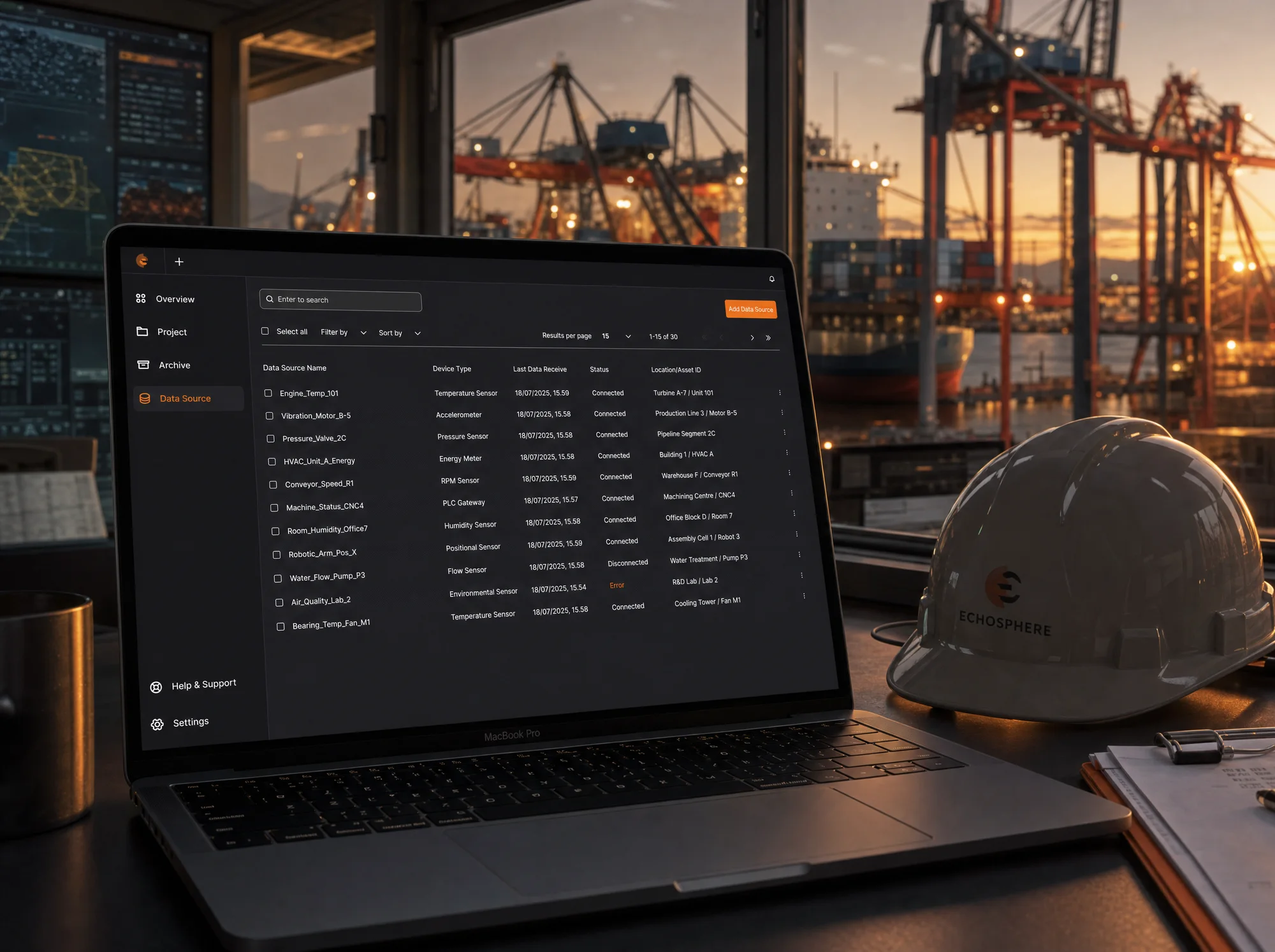
5-step wizard supporting MQTT, HTTP, Modbus, OPC-UA, and serial. Live data preview panel shows incoming readings immediately on connection, users confirm the data is real before attaching anything to the model.
Built the design system from scratch across the 3-year engagement. Handover documentation covered component specs, interaction states, and edge case handling so engineering could build without constant design input.
The solution
Three product decisions carried the platform, each shaped by what industrial users could realistically operate on their own.
A connector that proves itself
The data source connector is a five step wizard supporting five sensor types, with a live preview panel that shows incoming readings the moment a connection is made. Users confirm the data is real before attaching anything to the model, which removed the platform's single biggest moment of doubt.
- Five sensor types covered the full range of client hardware from day one.
- The live preview turns an abstract connection into visible, moving proof.
- Each step validates itself, so a failed connection never travels downstream.
The connector wizard: five sensor types, with live readings previewed before anything attaches to the model.
Direct manipulation on the twin
Clicking any asset in the 3D viewport opens a context panel with four options: add a data chart, add an annotation, add a scene camera shortcut, adjust position. Everything is spatial and direct. There is no abstract settings page standing between an engineer and the crane they are looking at.
- Charts attach where the data lives, on the asset itself.
- Annotations and camera shortcuts keep site knowledge inside the twin.
- The interaction model matches how operators think: point at the thing, act on the thing.
Spatial chart attachment: click any asset on the model to act on it directly.
Alerts without code
The trigger alert builder is fully no code. Users define if then rules, such as a temperature threshold sending a notification, without SQL or scripting. Three severity levels, Information, Warning and Danger, each carry different notification behaviour so engineers can tune urgency to consequence.
- If then conditions read like the sentences engineers already use.
- Three severity levels separate awareness from action from emergency.
- Notification behaviour scales with severity, protecting attention as well as safety.
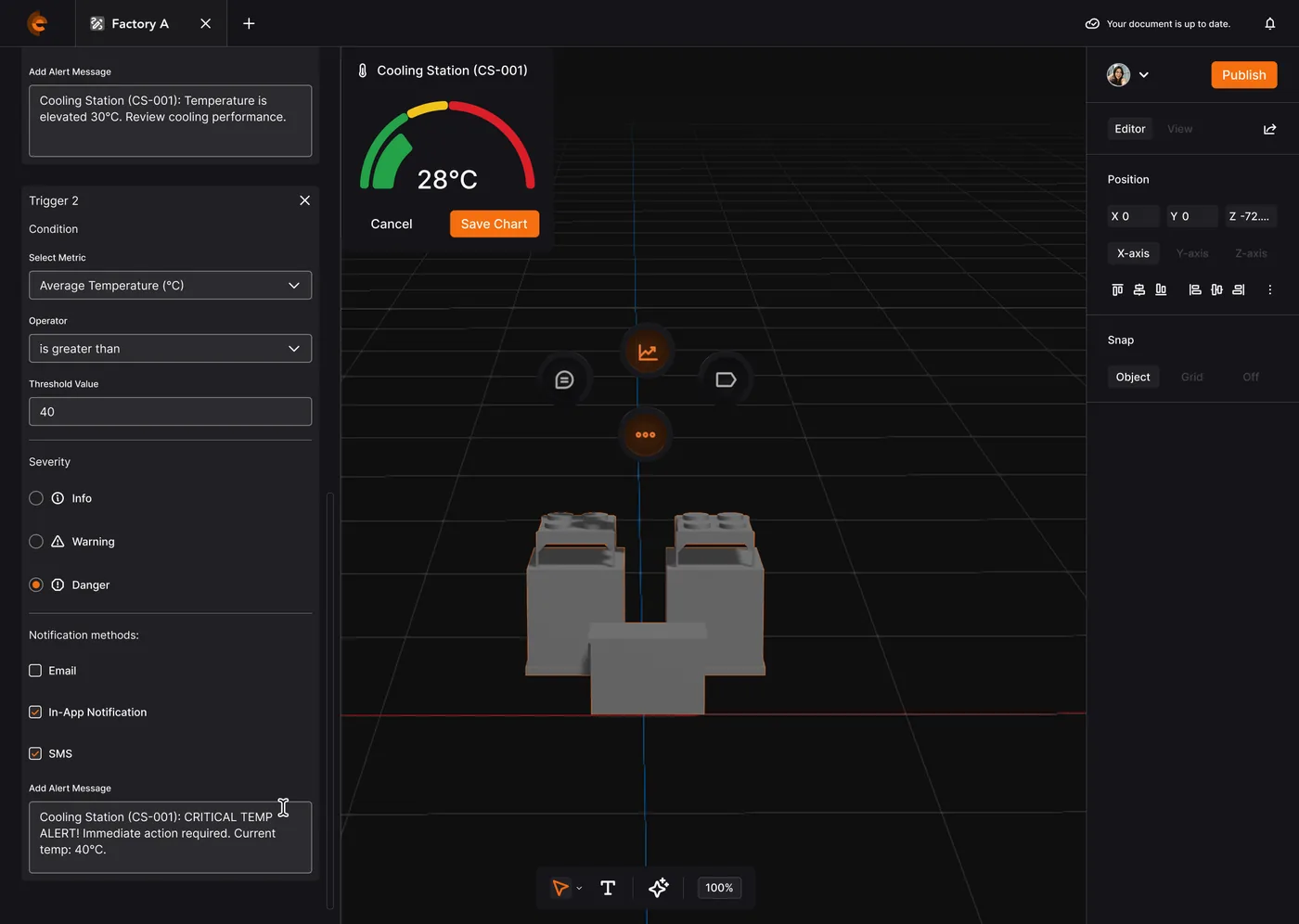
The no code alert builder: if then rules with Information, Warning and Danger severities.
Results overview
All screens
Outcomes
What it became
The platform shipped and won enterprise contracts with Keppel, DB Schenker, Hamburg Port, Omron AGV, HP Indigo and JamK Cyber Sec, six clients in three years, each on a different use case.
The results live in the clients' own published numbers: Keppel cut on-site inspection times by 50% with the 5G shipyard twin, which also meant engineers spent half as many hours exposed to an active yard, DB Schenker improved goods handling efficiency by 30%, and Omron raised its AGV engineering efficiency by 40% by simulating robot deployments on the twin before committing them to the floor. The HP Indigo deployment, which unified the plant's Operations, Production and Monitoring systems on the platform, was shortlisted for the SICC Awards 2022 as Most Sustainable Collaboration of the year.
The product went from a prototype built in the first four months to a commercial platform with recurring contracts and a 25% lift in the sales pipeline. Industrial clients bought it because their own engineers and safety officers could operate it without us in the room.
What the work taught me
Three years, six clients and two hats left lessons that have outlasted the product itself.
Bought by one person, used by another
Enterprise products are bought by people who will never use them and used by people who never chose them. Designing for that split, executive legible demos on top of operator proof workflows, was the real zero to one work, and it is the lens I bring to every B2B product since.
The system outlasts the screens
The design system, naming conventions and handover documentation set up in year one are what let a four engineer team build across six very different client deployments without a designer in every room. Carrying the product manager hat as well taught me the system matters more than any single screen.
Go where the work happens
The decisions that won contracts traced back to standing in the crane yard rather than reading requirement documents. Two site visits produced more product truth than a quarter of stakeholder meetings.